Wix Loads Itself Before It Loads Your Business
You chose Wix because it promised a professional website without requiring a developer. That promise is largely kept — Wix sites look good, they are easy to manage, and the templates are genuinely well designed. The problem is what Wix loads before your content reaches a visitor who has just tapped your paid ad.
Every Wix page loads Velo, Wix's proprietary JavaScript environment — the framework formerly named Corvid. It loads the Wix runtime. It loads the analytics stack. It loads the font delivery system. It loads the responsive layout engine. Much of this fires before your headline, your product image, or your call to action is visible on screen. The user who tapped your Google Ads listing on their phone is watching a blank screen load infrastructure they will never interact with.
This article does not ask you to take that on trust. Everything below is a measurement you can reproduce in about ninety seconds.
The Measurement — wix.com, 3 September 2026
Google PageSpeed Insights, mobile, emulated Moto G Power on Slow 4G. The page tested was https://wix.com — Wix's own homepage, the page Wix controls most tightly and has the strongest commercial reason to optimise.
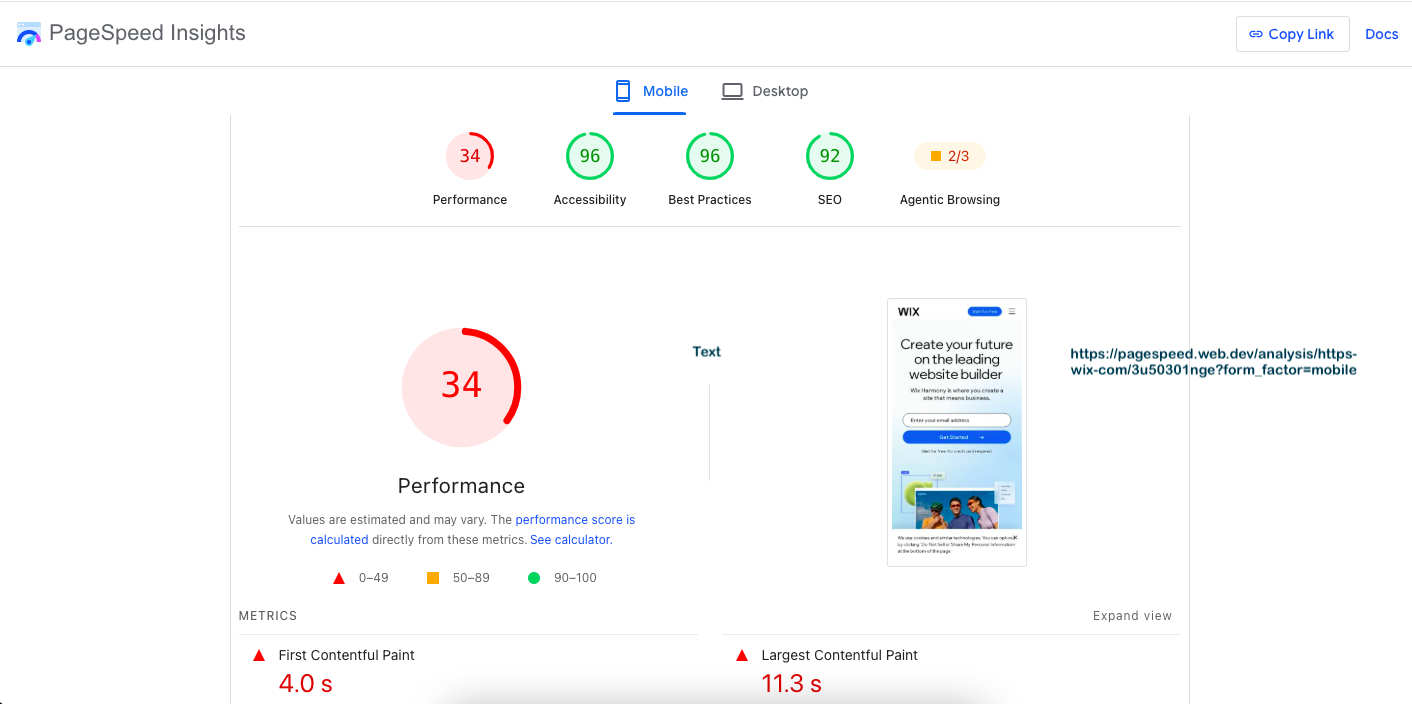
Open the live report and run it again yourself. Lab scores vary between runs, so take the median of three in a private window. The picture does not change.
| Mobile metric | wix.com | vGate edge page |
|---|---|---|
| Performance | 34 | 99 |
| First Contentful Paint | 4.0 s | 1.7 s |
| Largest Contentful Paint | 11.3 s | 1.7 s |
| Total Blocking Time | 1,790 ms | 0 ms |
| Cumulative Layout Shift | 0 | 0 |
| Speed Index | 6.6 s | 1.7 s |
| Agentic Browsing | 2 / 3 | 3 / 3 |
Read the Largest Contentful Paint line again. 11.3 seconds. Google's own guidance puts the threshold for a good LCP at 2.5 seconds. This is not a badly built small business site with too many plugins — this is the platform's flagship page, built by the platform, for traffic the platform pays for.
What This Actually Means for a Paid Click
Google Ads rates landing page experience as one of three Quality Score components, alongside expected click-through rate and ad relevance. It is reported as a relative rating — Below average, Average or Above average — measured against other advertisers competing for the same keyword. There is no published PageSpeed number that acts as a pass mark, and anyone who quotes you one is guessing.
What is documented is the direction of travel. Google states that landing page experience influences Ad Rank, and Ad Rank determines both whether your ad shows and what you pay for the click. A slow page does not disqualify you. It quietly raises your entry price relative to a competitor bidding the same amount on a faster page. That is the Algorithm Tax™ — not a penalty you are notified about, a premium you are charged.
The second cost is the one nobody measures. A visitor who taps your ad on mobile and waits eleven seconds for the main content is frequently gone before it arrives. You paid for that click. Google recorded that click. Your analytics may never have loaded to record the bounce.
Which Core Web Vitals Actually Fail on Wix
An honest reading of the data above matters here, because it corrects something widely repeated about Wix — including in an earlier version of this article.
CLS (Cumulative Layout Shift) is not the problem. wix.com scored a perfect zero. Wix has clearly invested in reserving space for elements before they load, and on their own flagship page it works. Individual Wix sites with heavy hero sliders and third-party apps can still shift, but layout stability is not the platform-level failure.
LCP (Largest Contentful Paint) is the problem. At 11.3 seconds, the largest visible element takes more than four times Google's 2.5 second threshold to paint. On a paid click, that is the entire decision window and then some.
TBT (Total Blocking Time) is the other problem. 1,790 milliseconds of blocked main thread. This is the measurement behind an experience every mobile user recognises: the page has appeared, you tap a button, and nothing happens. The browser is still executing JavaScript and cannot respond to you yet. Nearly two seconds of a visitor tapping a page that looks ready and is not.
These two are architectural. They are the cost of shipping a full application runtime to a phone before showing a headline, and no amount of image compression inside the Wix editor moves them.
Wix Is Not Ignoring This
It is worth being fair about what Wix has and has not done, because the fair version is more useful than the unfair one.
Wix scores 96 on Accessibility, 96 on Best Practices and 92 on SEO. Those are good numbers and they are not accidental. Wix publishes a performance page, runs a Site Speed Dashboard, and ships multi-CDN delivery and automatic image optimisation. The engineering attention is real.
It has not moved the Performance score to 34, and that is the point. When a company with Wix's resources, optimising its own homepage, lands on 34, the constraint is not effort or budget. It is what a full drag-and-drop application runtime costs when it has to execute on a mid-range phone over a slow connection. Your site inherits that constraint the day you sign up.
The AI Retrieval Gap
The Agentic Browsing row in the table is the newest line in the PageSpeed report and the one most people have not looked at yet. It scores how readily an automated agent — a search crawler, or an AI assistant fetching a page to answer a question — can retrieve and parse your content.
wix.com scores 2 out of 3. A vGate edge page scores 3 out of 3.
This matters more every quarter. ChatGPT, Gemini, Perplexity and Google's AI surfaces retrieve clean, fast, semantically structured HTML. Pages that depend on a JavaScript runtime to assemble their content get partial extraction or get skipped. If a prospect asks an assistant to recommend a supplier in your category and your page cannot be read in a single fetch, you are not in the shortlist — and unlike a Google ranking, there is no report telling you that you were considered and dropped.
The Subdomain Trap — And Why It Costs You Your SEO History
The standard workaround for Wix performance is to build your Google Ads landing page somewhere else — a dedicated landing page tool, a separate platform, or a subdomain. This solves the speed problem and creates an SEO (Search Engine Optimisation) problem you may not notice for months.
Every organic ranking signal, every backlink, every Google Business Profile citation, every E-E-A-T (Experience, Expertise, Authoritativeness, Trustworthiness) signal your Wix site has accumulated lives on your primary domain. Google treats a subdomain as a substantially separate entity for many of these signals. Your AEO (Answer Engine Optimisation) citations — where AI assistants reference your business when answering queries in your service area — point to your domain. Split your landing pages off and you split your authority.
For a small business that has spent two or three years building local SEO signals on their Wix site, the naive subdomain approach means starting over on exactly the pages that matter most for paid conversion.
The Reverse Proxy Fix — Edge Delivery Without Leaving Wix
A Cloudflare Workers reverse proxy sits at the network edge and answers the request before it reaches Wix's servers. When a user clicks your Google Ads or Meta Ads creative, the request hits a Cloudflare edge node — typically within 20 milliseconds of the user — and receives a pre-rendered, edge-cached version of your landing page, without the Velo runtime in front of it.
The user lands on your own domain. The page paints in well under a second. Your Wix site is untouched: you manage content in the Wix editor exactly as before, and your domain, backlinks, GEO (Generative Engine Optimisation) signals and organic rankings stay where they are and keep accumulating.
What the architecture delivers is not a claim you have to take on faith either. The page you are reading this on runs the same edge stack, with Google Drive as the CMS behind it. Measured on 3 September 2026 — same test, same emulated device, same throttling as the Wix report above: 98 Performance, 1.7s First Contentful Paint, 1.7s Largest Contentful Paint, 0ms Total Blocking Time, 0 Cumulative Layout Shift, 3.1s Speed Index, 3/3 Agentic Browsing. Run it on this URL yourself.
The honest boundary: a proxied page is not a magic wand applied to an entire Wix site. It is a targeted fix for the pages where speed converts into money — the destinations you send paid traffic to. Checkout flows, member areas and anything requiring Wix's native session handling stay on Wix, and the visitor transitions into them without interruption.
vKernel™ and the Signal Reclamation Layer
Wix's built-in analytics and third-party pixel integrations fire client-side. On a page that takes eleven seconds to paint its main content, a meaningful share of paid bounces happen before those pixels execute. Your conversion data is incomplete, and both Google's and Meta's delivery algorithms are optimising against a signal set with holes in it.
vKernel™ deploys a server-side event capture layer at the Cloudflare edge. The session is recorded from the moment the request arrives — before any framework loads and before any pixel has a chance to fail. Ad blockers cannot intercept server-side events and cookie expiry does not end a server-side session. The delivery algorithm receives complete data and optimises against your actual customers rather than the subset whose browsers cooperated.
The two fixes close two different leaks. Edge delivery closes the Latency Tax. Server-side capture closes the Signal Leak. Quality Score is calculated on a faster page, and the Algorithm Tax™ falls.
Frequently Asked Questions
Can I speed up my Wix website for Google Ads?
Not substantially from within the platform. Wix does not permit modification of its core framework, script loading order, or server-side rendering pipeline. The performance ceiling is set by Wix's infrastructure — which is why wix.com's own homepage scores 34 despite Wix having every resource and every incentive to do better. The reverse proxy approach bypasses that ceiling by serving paid landing pages from Cloudflare's edge network instead.
Does Wix affect Google Ads Quality Score?
Yes, through the landing page experience component. Google reports it as a relative rating — Below average, Average or Above average — measured against other advertisers on the same keyword, not as a PageSpeed number. A slower page does not stop your ad running; it raises what you pay relative to a competitor bidding the same amount on a faster one. Anyone quoting you a precise percentage increase is inventing it. What you can verify is your own score, and theirs.
Is CLS a problem on Wix?
Less than commonly claimed. wix.com scored a perfect 0 for Cumulative Layout Shift on 3 September 2026, so layout stability is not the platform-level failure. Individual Wix sites running heavy sliders or multiple third-party apps can still shift. The failures that hold across the platform are Largest Contentful Paint and Total Blocking Time.
Will switching from Wix to WordPress fix the speed problem?
Not automatically. A poorly configured WordPress site with a stack of plugins routinely scores lower than a Wix site. Platform migration is a significant investment with no performance guarantee attached. Edge delivery improves the pages that carry paid traffic without migration risk, cost, or SEO disruption.
Does the reverse proxy work for Wix e-commerce pages?
For landing pages and product pages used as paid ad destinations, yes — the edge-served version delivers the same content substantially faster. Checkout flows that require Wix's native session handling remain on Wix, and the visitor moves from the edge-served page into standard Wix checkout without interruption.
Why does my Wix site look fast on desktop but slow on mobile?
Desktop connections are faster and desktop processors are far more powerful, which masks JavaScript execution cost. A mid-range phone on a throttled connection — which is what Google measures with — exposes the full weight of the runtime. Google evaluates landing page experience using mobile as the primary signal. A site that feels instant on your office laptop can be failing every mobile user who clicks your ads.
How do I check my own numbers?
Open PageSpeed Insights, enter your landing page URL, select Mobile, and run it three times in a private browsing window. Take the median. If Largest Contentful Paint is above 2.5 seconds or Total Blocking Time is above 200 milliseconds on the page your ads point to, you are paying the Algorithm Tax™ on every click you buy.
Ready to Fix This on Your Site?
Run your site through PageSpeed Insights and send me the score. Free diagnosis. No pitch. Just the numbers.