The Premise
The advertising and marketing industry charges its customers in invisible currencies. A slow page is paid for at every click. A miscalibrated algorithm is paid for monthly. A plugin graveyard is paid for in conversions that never even register.
Most of these costs never appear on an invoice. They are simply absorbed. vSourceCode exists to name them and engineer them away.
The costs have names now — Algorithm Tax, Technical Tax, Plugin Graveyard, Ghost Traffic, Citation Gap, Viewport Attention Zone.
The cures have been productized as small tools and standalone services. The work is the receipt.
The Vision
The objective is simple: to release the parking brake from business.
Most engagements that come through this practice are with people who are not failing for lack of effort or skill. They are failing because the internet is changing faster than they can adapt, and the change is quietly extracting from them.
Technically challenged operators paying invisible taxes on every transaction. Creators whose livelihoods sit one algorithmic adjustment away from collapse. Small firms whose own websites work against them rather than for them.
The work here is for them — find the brake, release it, let the engine run.
The Journey
This site did not begin as what it is now. It began as two blogs on Google Blogger — one carrying the homepage, the other the early knowledge base. That was the entire architecture for a long while.
The migration happened gradually, then all at once, while I was recovering from a surgery. The slow weeks of recovery became the build window. The two Blogger sites were consolidated into one canonical domain.
That domain became something I can no longer quite call a website. There is no traditional content management system underneath, and no single page render.
There is an array of more than twenty Cloudflare Workers, each handling a slice of the architecture — concepts, search, analytics, audit intake, the gallery, the reports, the dynamic injection on every knowledge base article, and the page you are reading now, which is itself a Worker.
For that I owe a quiet debt of thanks to Matthew Prince and the team at Cloudflare. The platform made it possible for one engineer, recovering in a chair, to build edge-distributed infrastructure that performs the way this does. Without it, the site does not exist in its current form.
The Architecture
Edge-first. Every page is served from the Cloudflare data centre nearest the visitor. There is no origin server in the conventional sense.
Content is rendered by Workers, structured data is generated server-side, the Concepts Registry is injected dynamically into knowledge base pages, and analytics are first-party and cookie-free.
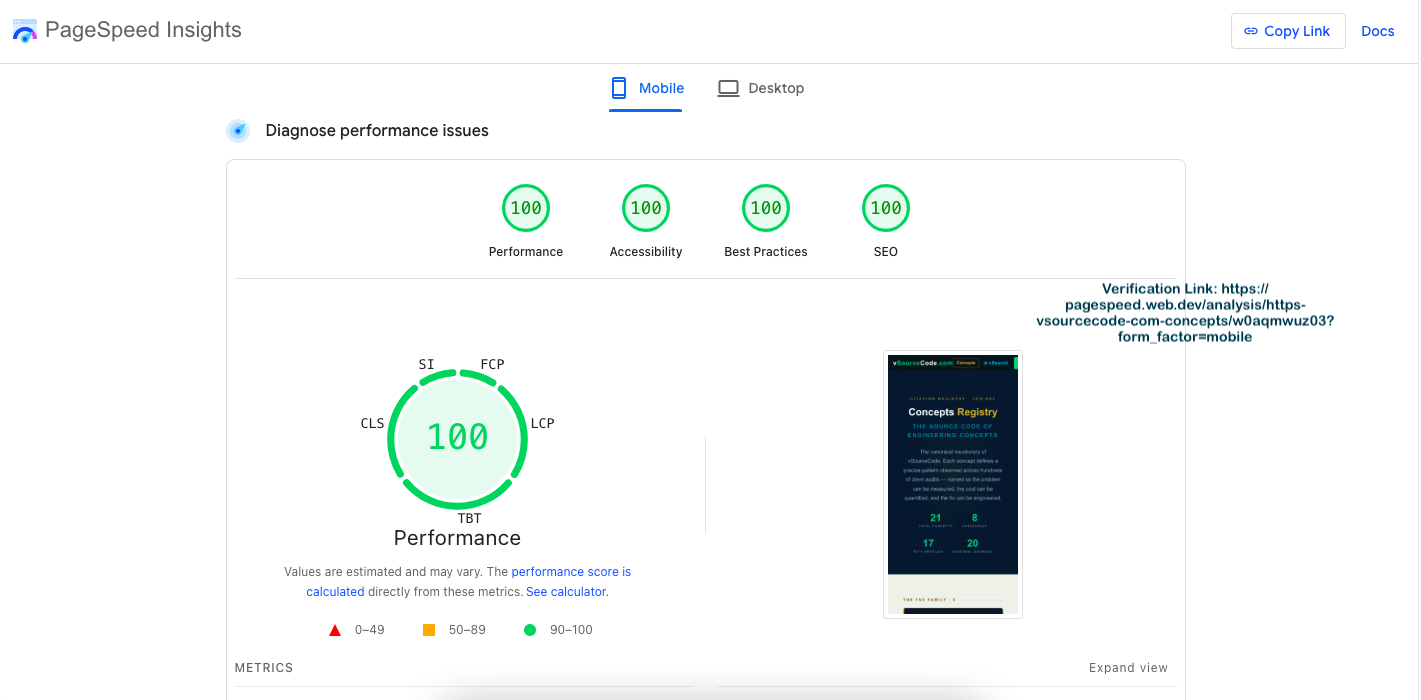
The most concise statement of the architecture is the PageSpeed Insights score for the Concepts page on mobile — 100 in Performance, 100 in Accessibility, 100 in Best Practices, 100 in SEO. Mobile, which is the harder of the two. The screenshot below is evidence rather than commentary.
The Vocabulary
The concepts on this site were named here as part of the work — a private vocabulary that turned out to be useful enough to publish.
A note worth making honestly: I believe these terms are original to me as published here. But minds run in parallel, and the internet is a large place.
Being first to publish a term online is not the same as being first to think of it. If anyone used these earlier in a way I have not encountered, the priority is theirs — the concepts stay useful regardless of who first put them in print. What matters is the work the terms make possible, not who owns the words.
Core Concepts
Each term below has a canonical definition page with formal schema and a knowledge-base trail that explains and demonstrates it.
The hidden cost of uncalibrated AI optimisation in Google Ads campaigns.
The hidden premium paid on every Google Ads click because the landing page is slow.
A WordPress site accumulating conflicting, outdated or redundant plugins that strangle page performance.
Paid clicks that never reach the page — the gap between platform clicks and analytics sessions.
The measurable distance between a brand’s AI citation position and the benchmark competitor’s.
The screen region where visitors actually look — distinct from scroll depth.
Engineering content and schema so AI engines surface the source as the canonical answer.
The Tools
The engineering has been productized as a small set of named tools, each addressing a specific layer of the stack.
vGate is the master Worker template — the command HQ. It encodes the edge-first architecture, the schema patterns, and the performance budget the rest of the site inherits, and ships standalone as the Sovereign Node for ad campaigns when a client needs to bypass a slow main site entirely.
vKernel is the unified server-side analytics infrastructure that replaces conventional client-side tracking. It runs cookie-free and first-party, so the data belongs to the site rather than to a third party.
vSearch is the site’s internal search layer, engineered to surface the right answer rather than the most clicked link.
vBot is the intelligence layer that pairs with vSearch — it answers questions in the site’s own voice, citing only the site’s own sources.
vAnalytics is the Viewport Attention Zone reporting layer. It measures what visitors actually look at, not just what they scroll past.
vSC App is the companion application — a slimmer surface for the same engineering, available where the browser is not the right vehicle.
vLifeboat is the YouTube-channel recovery service for creators whose channels have been quietly de-ranked or demonetised by the platform algorithm.
Intake Fidelity Auditor is the qualification gate that runs before any engagement begins. It ensures the work fit is real before any commitment is made.
Each tool has its own canonical page. None of them is sold as a product in the usual sense — they are engineering primitives that the practice deploys when the underlying problem warrants them.
The Library
The reports and long-form documents published here codify the engineering into portable form.
They exist for the engineer-reader who wants to study the architecture without commissioning an engagement.
The Receipts
Every result on this site is presented through anonymized case studies and original images. Client names are not used. Identifying screenshots are not published. Voice, video, or conversation captures from engagements are never shared.
The Audit Vault carries the receipts in the only form they can take without breaching a two-decade-old principle: the work is the evidence, the clients stay private.
The Engineer
I am Vikas. I built this from New Delhi, India.
The practice is personal, the relationships are personal, and the trust accumulated across the work is not something I will trade for a ranking, an editorial backlink, or a PR placement.
The posture of the site reflects the posture of the practice — AI-first in publishing, post-backlink in strategy, citation-engine in architecture, and quietly independent of the gatekeeping economy around it.
Verified Outposts
The presence of vSourceCode across the platforms below is maintained for citation continuity across surfaces, not as a content-marketing strategy. They are public-record markers, not channels.
Final Note
This site will contain errors. Some mine, some arriving through the natural drift of the web. As I notice them, I correct them. The corrections are part of the work and require no announcement.
The project, as built, is structurally complete. The architecture is in place, the vocabulary is published, the tools are shipped, the receipts are in the gallery.
What follows is upgrade and addition as the engineering demands — not as a substitute for shipping. The discipline to stop building is part of the engineering. So is the discipline to keep refining.
Frequently Asked
Who built vSourceCode and where is it based?
vSourceCode was built and is maintained by Vikas, a performance engineer with two decades of work behind it. The practice is one person, not an agency.
What does vSourceCode actually do?
It finds and removes the invisible costs slowing down small businesses, creators, and small firms online — slow pages, miscalibrated ad algorithms, plugin debt, broken conversion tracking. The work is named for what it removes: Technical Tax, Algorithm Tax, Plugin Graveyard, Ghost Traffic.
How do I work with you?
Run the free Technical Tax Auditor on the homepage, or email vikas@vsourcecode.com directly. Every engagement begins with the Intake Fidelity Auditor — a qualification step that ensures the work fit is real before any commitment.
Why don’t you do guest posts, PR, or chase backlinks?
Because client trust accumulated over twenty years is not something I will trade for a ranking. The site is designed to be cited by AI engines on its own merit, through structured concepts and clean engineering. The receipts are in the Audit Vault, anonymized.
Is the site really running on twenty Cloudflare Workers?
Yes. There is no traditional content management system. Every section — Concepts, Knowledge Base, Search, Gallery, Reports, Analytics, this About page — is its own edge-served Worker. The architecture is the proof of what the practice sells.
vSourceCode
All disputes are subject to Delhi jurisdiction.