Grow Beyond YouTube with AI Search Visibility & Owned Email List
Turn viewers into subscribers you own with self-hosted videos, an owned email list, and a creator website that expands your visibility across Google Search, AI Overviews, ChatGPT, Gemini and Claude.
One deployment gives you four things a channel cannot: a website on a domain you own, an email list that survives anything YouTube does, a video library that AI engines can read and cite, and — for the first time — an advertising destination you are allowed to put a pixel on.

Every creator is on one of these two roads
One of them ends with an AI engine naming you when someone asks who to watch in your niche. The other ends with your best work sitting behind a login you do not control, unreadable to the systems now deciding what gets recommended.
Why does growing off YouTube grow the channel?
Because you cannot install a tracking pixel on a YouTube channel. That single fact decides how you are allowed to advertise, measure and retarget — and a domain of your own is what removes it.
You cannot pixel a channel
There is no way to place a Meta pixel, a Reddit pixel or any third-party tag on your YouTube channel.
No pixel means no retargeting audience, no conversion tracking, no lookalike modelling. Every view stays an anonymous, rented impression — one you cannot follow up, segment, or rebuild if the channel goes.
One ad lever, owned by one company
Without a site of your own, your only paid lever is Google Ads pointed at Google's platform and measured by Google's reporting — inside the same ecosystem that can suspend the channel you are advertising.
A domain changes the destination. Meta, Microsoft Advertising, Reddit and native networks all accept a real website as a landing page. Meta does not ban YouTube links; it deprioritises off-platform links, which is exactly what a destination you own solves.
A paid click becomes an owned asset
On your domain the pixel goes on, retargeting becomes possible for the first time, and email capture turns a paid click into a subscriber you keep instead of a view you rented.
The videos stay embedded, so plays and watch time are still credited to your channel. The site feeds the channel. It does not compete with it.
Why do AI engines cite websites and not channels?
Because an answer is assembled from indexed web pages. When someone asks ChatGPT, Gemini, Claude, Perplexity or Copilot to recommend a creator in your niche, the model is drawing on pages it can read, attribute and link.
A YouTube channel builds that authority on Google's domain, not on yours. The descriptions under your videos are not a citable source, and the channel page is not an entity an engine can attribute to you.
A fast, indexed domain carrying your name, your work and your expertise is the only asset in this picture that an AI engine can point back at you. That is the second discovery layer, and most creators have nothing in it.
What does a vLifeboat™ Node look like?
Your content, on your domain. Mirrored from YouTube through the Data API, searchable through vSearch, and served from the edge in under a second on mobile.
Illustrative layout. Your node is built against your own channel at deployment.
What is included in one deployment?
Eight systems. One engineer. One invoice. Deployed in 48 hours.
YouTube API mirror — vBot
vBot pulls your channel metadata, thumbnails, titles and descriptions through the YouTube Data API v3. The gallery rebuilds itself. Every new video appears on your domain within minutes of publishing, with no manual sync.
Auto-syncR2 video archive
Cloudflare R2 storage for your source files, with zero egress fees and edge delivery. Some creators want a complete backup of everything they have published; others only need the pages indexed and citable.
Scope is decided at the audit and priced accordingly, because storage and bandwidth are real costs.
Scoped — priced at auditvSearch — channel-scoped
Full-text search across your video library and archive, scoped to your channel. Visitors find your back catalogue instead of bouncing. AI assistants get a structured surface to index, with a citation string attached to every result.
AEO-readyOwned email list
Subscribers enter their email on your domain. It writes straight to your own Google Sheet — no ESP in the middle, no platform terms, no migration risk.
Export as CSV in thirty seconds, at any time, whatever else is happening.
Platform-independentV Analytics — server-side
Every session captured at the Cloudflare edge. Ad-blocker proof and cookie-free. You can see which video drove a sponsor enquiry and which search brought a subscriber — real data, not privacy-filtered estimates.
Zero cookie wallsAdSense-ready domain
Your domain can qualify for Google AdSense independently of your channel — a second revenue line on an account of your own. If the channel is demonetised, site monetisation is unaffected.
Independent revenueOutpost architecture
Substack, Quora, Medium, Bluesky and Pinterest, all pointing back at your domain. Every mention builds the entity an AI engine has to recognise before it can cite you. The authority accumulates on the asset you own.
E-E-A-T signalsReverse proxy speed layer
If you already run a Wix or Squarespace site, the reverse proxy serves fast landing pages under your existing domain without touching it. No migration, no rebuild.
Optional add-onWhat happens if the channel is terminated?
The subscribers do not come with it. They were never your contacts — they were YouTube's, shown to you as a number on a dashboard. An email list is the one part of an audience that survives a platform decision, because it lives in a file you hold.
Through late 2025 and into 2026, YouTube ran a large enforcement wave against low-quality automated content and terminated channels at scale. Creators who had built nothing outside the platform had no way to tell their audience where they had gone.
The same exposure applies to Instagram and Facebook Reels, where many of the same creators publish. One domain, one email list and one archive cover all three — and none of it needs the channel to be in trouble to be worth having.
Why do sponsors leave before the page loads?
A brand manager finds your channel and clicks the link in your bio. The site takes five seconds to appear on mobile. They are evaluating thirty creators this week.
They move on before your headline finishes rendering, and you never find out it happened — there is nothing in YouTube Studio that reports a sponsor who left.
A fast, well-built page on your own domain communicates infrastructure quality before a single word is read. V Analytics then tells you which video sent them, which is the number a sponsor actually wants to hear.
One engineer, and a public record
There is no agency, no account manager and no team behind this. Vikas builds it, and the work is checkable before you commit to anything.
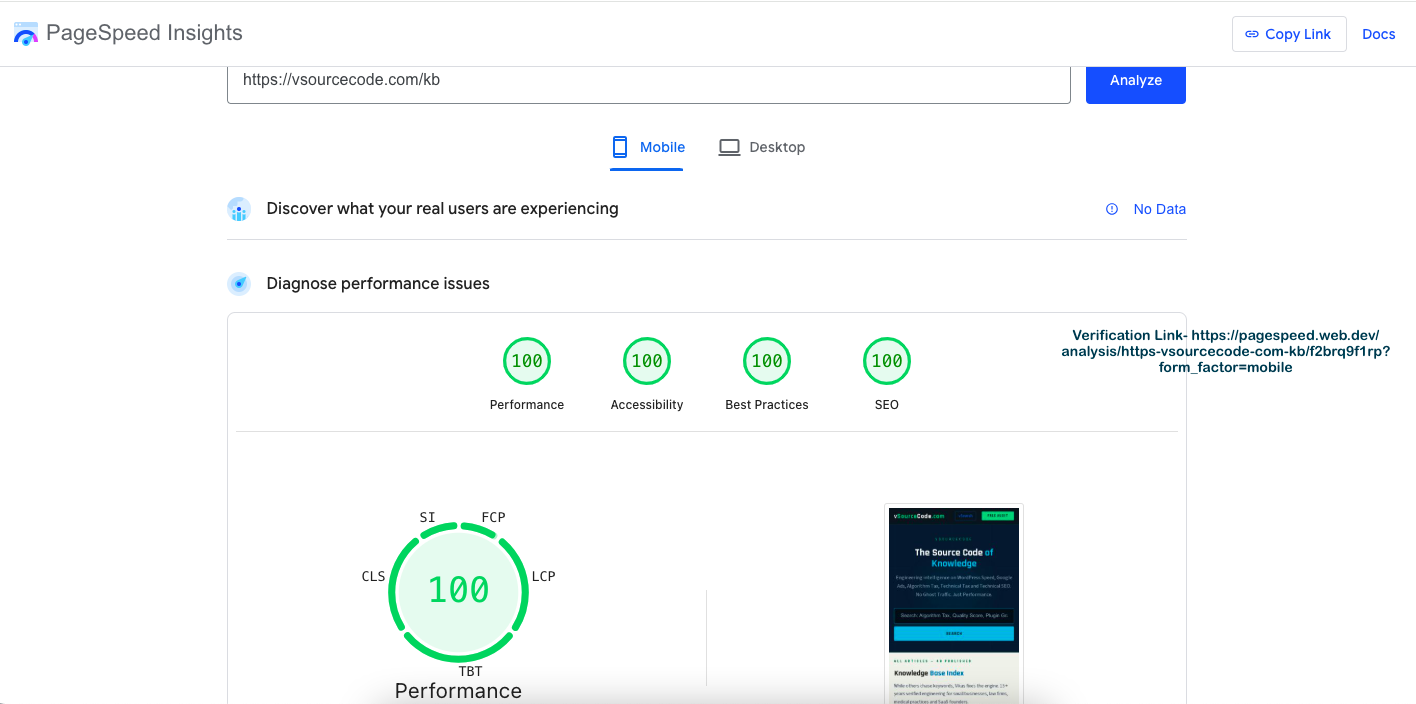
PageSpeed Insights, mobile, on a page built the way yours would be. The verification link is in the shot — run it yourself.
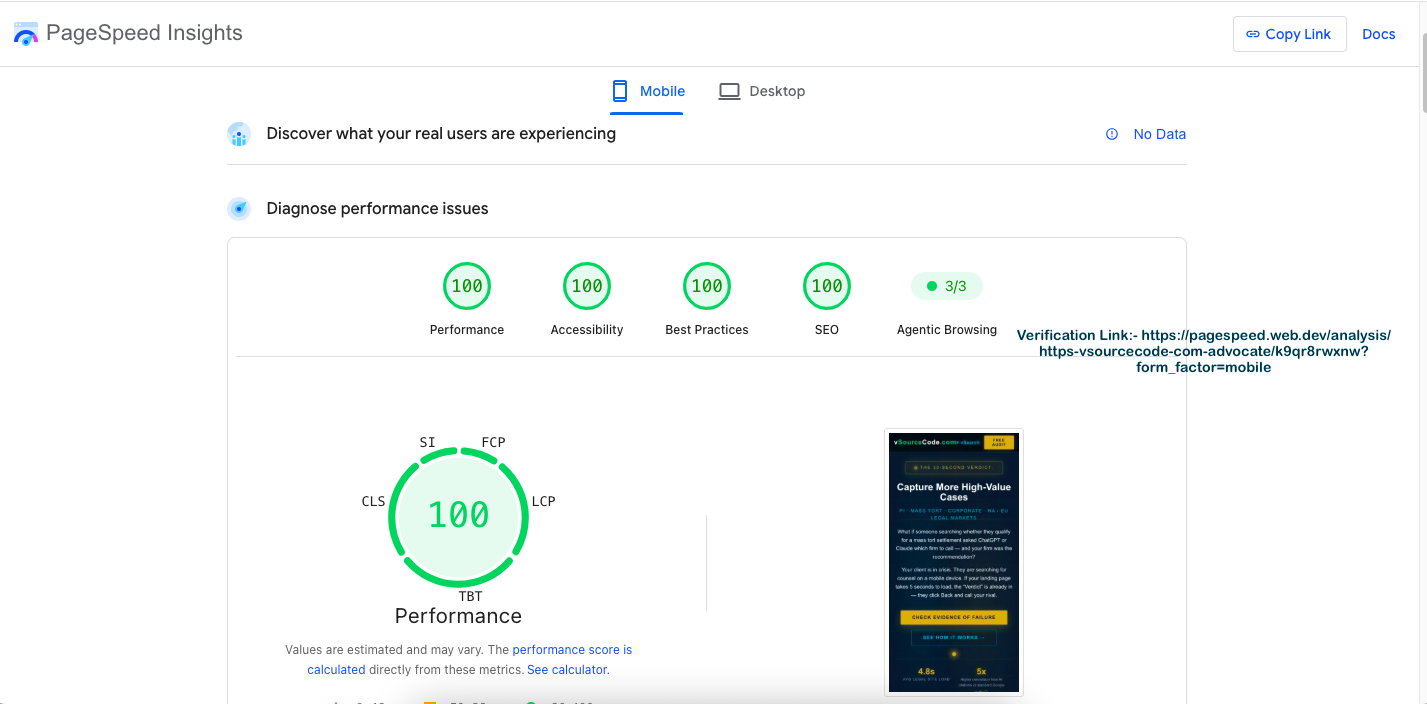
The Advocate node, same stack, same result. This is the infrastructure the vLifeboat™ Node is built on.
15 years of performance engineering
Google Ads engineering, technical SEO and page-speed work — the same discipline behind Technical Tax™, Algorithm Tax™ and the vKernel™ stack.
A published book on AI visibility
GEO for Website Owners — the standard this page is built to, including its rules on headings, one-claim paragraphs and answering before elaborating. Browse eBooks →
The Audit Vault
Real audits, published rather than described. Read the diagnoses before deciding whether the diagnosis is any good. Open the Audit Vault →
Infrastructure you can measure now
Run this page and the rest of vsourcecode.com through PageSpeed Insights before you talk to anyone. The claim is testable in about thirty seconds. Read the Knowledge Base →
The vLifeboat™ Node runs on vKernel™ — the same infrastructure that powers Technical Tax™ audits for Google Ads clients. Server-side session capture, viewport attention mapping, conversion signal reclamation, and reports written in plain English. Your sponsors get real numbers instead of estimates.
Explore vKernel™ →One engineer. One invoice. No retainer until you've seen the numbers.
Pricing reflects the scope of your channel and what you actually want archived. Every engagement starts with a Sovereign Audit — a plain-English infrastructure report, at no charge, before anything is quoted.
- Custom domain setup on Cloudflare edge
- YouTube API gallery integration via vBot
- vSearch scoped to your channel
- Email capture to your own Google Sheet
- V Analytics server-side deployed
- Schema and AI-citation surfaces configured
- DNS configuration and SSL
- 48-hour deployment turnaround
- R2 source-file archive — scoped, priced at audit
- Reverse proxy speed layer
- Cloudflare Workers edge hosting
- R2 storage, sized to your archive scope
- YouTube API sync — daily, automated
- V Analytics data pipeline active
- vSearch index updates on new content
- SSL and DNS management
- Priority support direct from Vikas
- Cancel anytime — zero lock-in
Your domain, your email list and your archive are yours regardless of subscription status. This is not a platform. If you cancel the monthly, the files stay on your domain and the data stays in your Google Sheet. Nothing disappears and nothing is held.
Questions creators ask first
Apply for a Sovereign Audit
Vikas reviews your current setup and sends a plain-English infrastructure report — what you have, what you are missing, and what a vLifeboat™ Node would cost for your specific channel. No pitch, no sales call, just the numbers. Response within 24 hours.
Vikas responds within 24 hours. Privacy Policy