Google just added the 5th Element. Most websites do not have it.
A driver is rear-ended at 9pm and asks her phone for the best personal injury lawyer in her city. A homeowner asks an AI assistant to compare three solar installers in his state by the morning. A high-net-worth client asks the same assistant to find a tax strategist who handles offshore holdings.
None of them opens a browser. None of them types into Google. The agent runs the search on their behalf, scans the candidate sites in seconds, picks one, and either books the call or hands back a single recommendation. The human never sees the websites that lost.
This is who is visiting your site in 2026. And there is now a public score for whether they can use it.
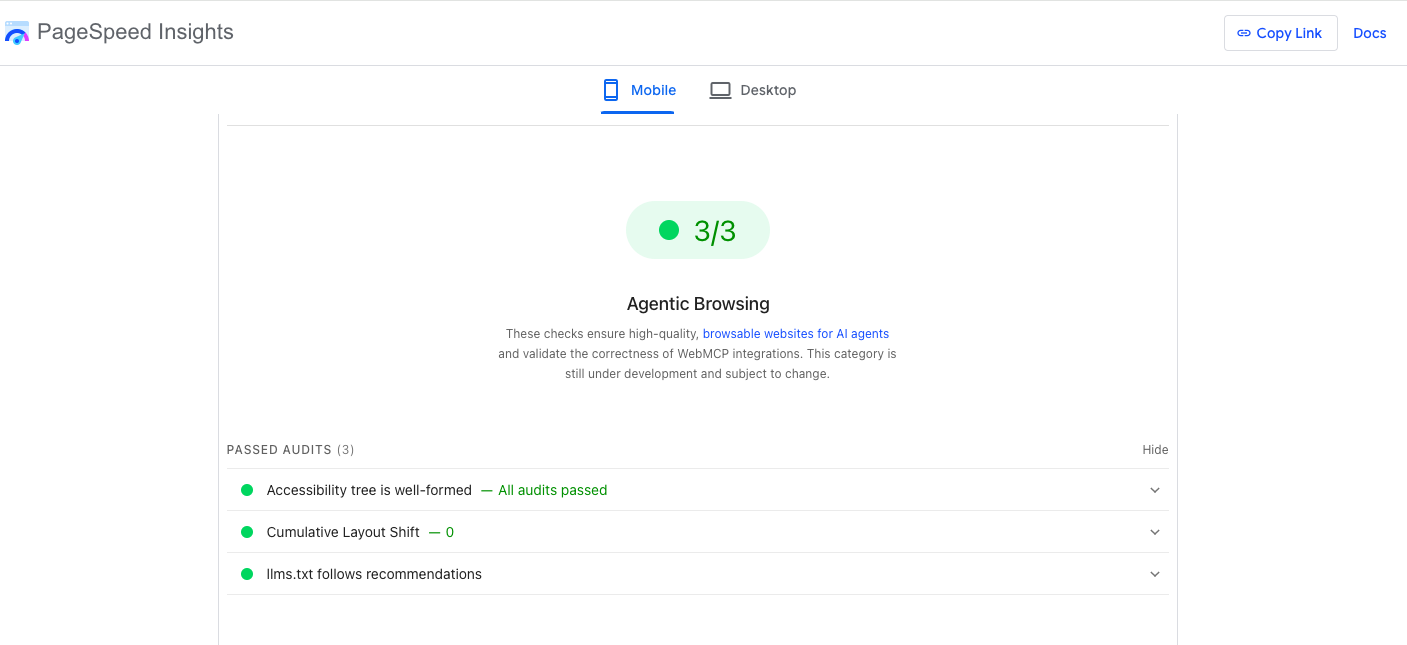
Agentic Browsing is the fifth audit category Google quietly added to PageSpeed Insights in June 2026. It scores whether AI agents — ChatGPT browse, Gemini, Claude with tools, Perplexity, and the new generation of autonomous browsers like Project Mariner and Computer Use — can read, interact with, and act on your website. The previous four columns audit your site for humans and search engines. The fifth audits it for the machines that are now doing the work on humans' behalf.
The audit you did not notice get longer
Someone in your industry opened their PageSpeed Insights report at the end of June and saw something they had never seen before. A fifth score on the page. Not Performance. Not Accessibility. Not Best Practices. Not SEO.
A fifth one, sitting quietly at the end of the row, labelled Agentic Browsing. They had never heard of it. Their site, which had passed every audit for years, scored zero out of three.
There was no plugin in their WordPress dashboard for fixing it. Their agency had not mentioned it. Their developer had not written a ticket for it. It was new. It had appeared without announcement. And it was scoring something that, until a few weeks earlier, had not been measurable at all.
In 2026, your customer's agent is the one visiting your site
The personal injury lead at 9pm. The solar installer comparison by morning. The tax strategist search. In each case, the human gives an instruction and the agent runs it. The agent does a background scan across the candidate sites. It picks one.
If your site lacks the edge-native structure that lets a bot ingest your offer cleanly in a single pass, you get skipped. You will not see a 404 in your logs. You will not see a bounced impression in Search Console. The lead does not arrive and there is no record that it was ever considered.
It is a ghost rejection. An outcome that never enters any system you own, because the decision happened inside an interface you have no access to.
This is the audience the fifth column was built for. Until June 2026, you had no way to measure whether your site served it. Now you do.
For two decades, the audit had four columns
Every PageSpeed report, every Lighthouse audit, every agency monthly, every developer ticket for fifteen years orbited the same four scores. They measured a site against the only audience that mattered: humans, and the search engines indexing pages for humans.
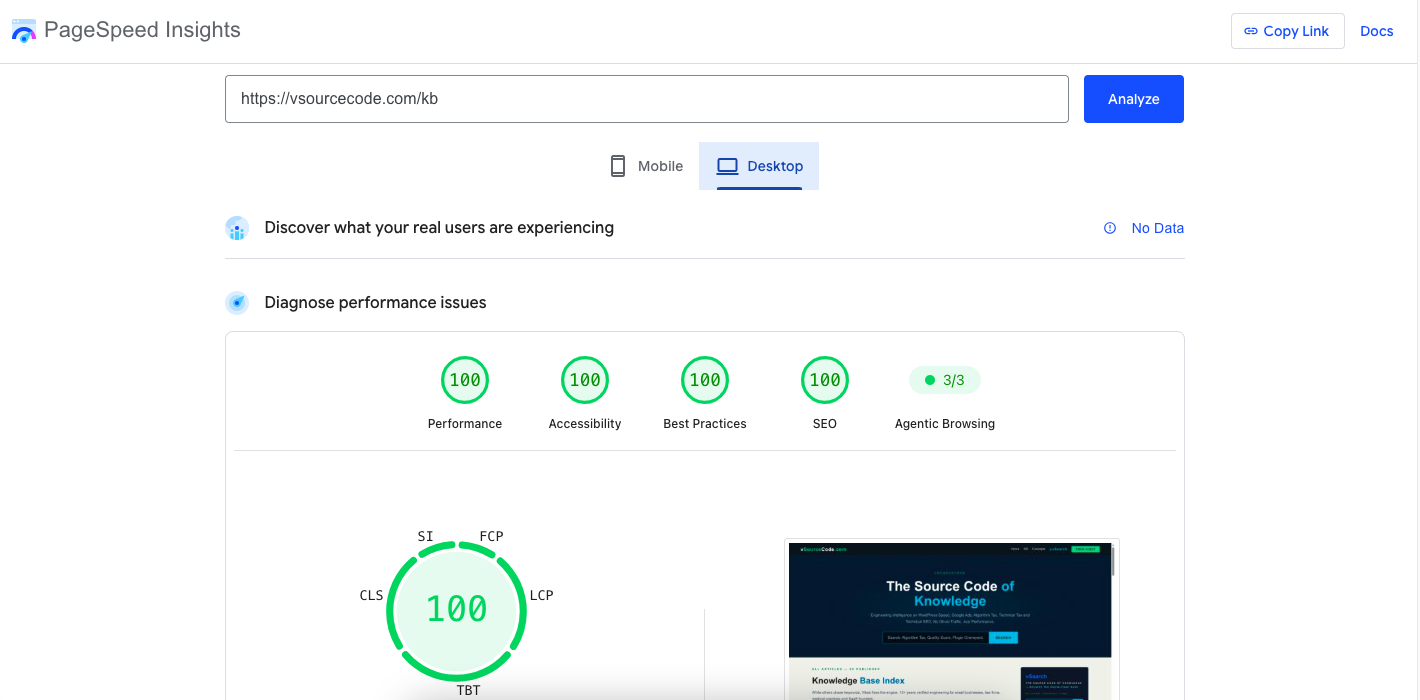
The four columns answered four questions. Then in June 2026 a fifth question quietly appeared.
The first four are all about a human or a human's proxy. The fifth is about an autonomous machine acting on a human's behalf. That is a different audience with different requirements. For the first time, it has a public score.
What the fifth column actually measures
Three checks, simple-looking on the surface, each tied to something a CMS cannot fix from the inside.
Why your twenty WordPress plugins cannot fix this
Your marketing agency promised you that your twenty WordPress plugins were harmless. They were optimising for old-school meta keywords, image alt tags, schema snippets, sitemap pings — the four-column world.
Then Google dropped a hammer called Agentic Browsing. Every unaligned script, every layout shift caused by a late-loading element, every missing root-level file became a brick wall to an AI crawler.
You did not fail a ranking test. You failed a machine-readability standard. To an AI agent, a non-compliant page does not just look worse than your competitor's. It looks like broken code.
The reason no plugin can patch this is structural. WordPress is PHP from the database query up. Every plugin is a PHP package hooked into the WordPress action and filter pipeline.
PHP errors — fatal errors after a version bump, deprecation warnings that escalate to exceptions, two plugins both trying to register the same hook with incompatible argument signatures — propagate up through the stack and break the rendered output in exactly the ways the new audit measures. A plugin error is not a separate problem from a layout shift. It is the same problem at a different altitude.
Even when the PHP runs cleanly, the page that emerges is a composite. Twenty plugins each appending their own JavaScript, their own CSS, their own DOM injections.
The cumulative output is what the AI agent sees. The cumulative output is what shifts during render. The cumulative output is what the accessibility tree has to traverse. No single plugin owns the result, which is exactly why no single plugin can fix it.
And the third check — llms.txt — sits at the root of your domain. /llms.txt, not /wp-content/plugins/.../llms.txt. WordPress cannot put a file there. No plugin can. It requires either edge-level routing or server-level file serving, both of which live outside the CMS.
The pattern is the same on all three checks: the fifth column scores something that does not live inside WordPress, and therefore cannot be fixed inside WordPress. Updating plugins, for the first time in twenty years, no longer satisfies the question "have you updated your website."

The screenshot is the new dimension
To see why Cumulative Layout Shift specifically became part of this audit, it helps to know what PageSpeed Insights actually does when you run it.
Lighthouse — the engine behind PSI — opens your page in a real headless Chrome instance and records a filmstrip. A series of frames captured at fixed intervals during render. The CLS score is calculated by measuring how much visible content moves from one frame to the next. It is a literal pixel measurement against a real camera.
Now consider how AI agents actually consume the web in 2026. ChatGPT and Claude with browsing primarily read the rendered DOM. Gemini is multimodal — it understands the visual appearance of pages, not just the HTML.
The new generation of agentic browsers — Anthropic's Computer Use, Google's Project Mariner, OpenAI's Operator — interact visually. They take a screenshot. They identify the target element at a coordinate. They click. They take another screenshot. They repeat.
This is the same camera that PSI uses, doing the same work, except in production for real users' tasks instead of in a test for a score. And it reveals what CLS now actually measures.
Layout shift is the moment an AI agent loses its place on your page. The agent took a screenshot. It identified Book Consultation at coordinates 420 by 680. In the milliseconds between the screenshot and the click, an ad slot loaded above the fold, pushed the button down ninety pixels, and the agent clicked an empty space. Failed task. The user, watching the agent try to book a service on their behalf, sees it give up and move to the next site on its list. Your competitor's. With CLS zero.
vSourceCode · Engineering Field Notes · 2026This is the fifth dimension of the audit. The previous four measured static properties — does it load, does it work, is it secure, does it index. The fifth measures something temporal: does it stay still long enough for an autonomous system to act on it.
A page that scrolls and shifts and reflows looks acceptable to a patient human. To an agent operating in milliseconds it looks like a moving target. CLS is, more than any other single metric, the difference between a site an agent can transact with and one it cannot.
You did not lose the customer because your offer was weaker. You lost them because the system trying to act for them could not get a stable grip on your page. The audit just gave that failure a number.
What "updating a website" now means
For two decades, updating a website meant patching the software. Clicking Update All in the WordPress dashboard. Watching the green checkmarks. Closing the tab, satisfied.
That definition was complete when the audience was humans and Googlebot. It is not complete when the audience also includes ChatGPT, Gemini, Claude, Perplexity, and the agentic browsers that route on their behalf.
The fifth column does not ask whether your plugins are up to date. It asks whether your page is built to be acted on by a machine that does not have hands, does not have patience, and does not give second chances. That is not a software-update problem. It is an infrastructure problem.
Edge-deployed pages — built outside the CMS, served from the global edge with zero render-blocking dependencies, with the llms.txt at the root, with the accessibility tree intact because there is no plugin layer fighting for control of the DOM — pass all three checks by structural default. They were never going to fail an audit that measures infrastructure properties, because they were engineered as infrastructure to begin with.
This is what the Sovereign Node concept describes, and what vGate ships as a deployable form. Not because the technology is exotic. Because building outside the CMS is the only place all three checks can be satisfied at once.
Most businesses will not deploy edge infrastructure tomorrow. That is fine. The first move is to know that the fifth column exists, that your site is being scored on it, and that the score is now visible to anyone who runs PSI on your domain.
Your competitors checking yours. The AI agents reading the score to decide whether to engage your site at all. The auditors at the next agency review wondering why nobody mentioned the new column for a quarter.
The four-column world is closed. The five-column world has been open since June. The audit on every site, including yours, has already started. The question is whether the score will be discovered by you, or by the audience the audit was built for.
Common questions about the 5th Element
What is the Agentic Browsing audit in PageSpeed Insights?
Agentic Browsing is the fifth audit category Google added to PageSpeed Insights in June 2026. It measures whether AI agents — including ChatGPT browse, Gemini, Claude, Perplexity and autonomous agentic browsers — can read and interact with your website. It contains three checks: a well-formed accessibility tree, Cumulative Layout Shift equal to zero, and an llms.txt file at the root of the domain that follows the published recommendations.
Why does CLS suddenly matter for AI search?
Because autonomous AI browsers interact with pages by taking screenshots, identifying a target element at a screen coordinate, and clicking. If the page shifts between the screenshot and the click — a late ad loading, a font swapping, an image appearing without reserved dimensions — the agent clicks an empty space. The task fails. CLS measures exactly the property that determines whether such an interaction will succeed, which is why it became one of the three Agentic Browsing checks.
Why cannot WordPress plugins fix the new audit?
All three checks measure properties that sit outside what plugins can control. The accessibility tree depends on the cumulative DOM output of every script and style on the page — no single plugin owns it. CLS depends on layout engineering across the entire render path. And llms.txt must be served from the root of the domain, which WordPress cannot do without edge or server-level routing. Plugin updates do not address any of these surfaces. The fix is at the infrastructure layer, not the CMS layer.
Will my Google rankings drop if I fail the Agentic Browsing audit?
Google has not announced that the Agentic Browsing score directly affects traditional ranking, and as of June 2026 it does not appear to. The more material impact is on AI citation. Engines that decide which sites to cite in their answers — ChatGPT, Gemini, Claude, Perplexity — increasingly use signals aligned with what the new audit measures. A site that fails all three checks is structurally less likely to be cited even if it ranks fine on classical Google. This is the gap the Citation Gap measures.
What is an llms.txt file and where does it go?
An llms.txt file is a plain-text Markdown document served at the root of a domain — for example, https://yoursite.com/llms.txt — that describes what the site is, what its canonical pages are, and what each one means in language an AI engine can ingest. It is the AI-era analogue of robots.txt, but for content discovery rather than crawl permission. The published recommendations for its structure live at llmstxt.org. PageSpeed Insights' Agentic Browsing audit checks for its presence, its required H1, and its inclusion of links.
How is this different from the AI Eviction Notice problem?
The AI Eviction Notice describes the macro shift — AI Overviews and AI engines answering customer questions above the search result, restructuring the implicit deal small businesses built their traffic on. The fifth-column audit is the operational consequence of that shift. Google has now formalised what infrastructure properties a site needs to remain visible to the audience that displaced the search result page. The Eviction Notice was the news. The Agentic Browsing audit is the compliance checklist.
What does "updating a website" mean in 2026?
It now means two distinct things. The first is the original meaning — keeping software, plugins, and security patches current — and that still matters for the four original audit columns. The second is engineering the page so that it satisfies the fifth column: a clean accessibility tree, zero layout shift, and an llms.txt file at the root. The first is a CMS-level discipline. The second is an infrastructure-level discipline. A site that does only the first will pass four columns out of five, which until June 2026 was a complete pass and is no longer.
Sources & references
Google PageSpeed Insights — Release notes & category documentation (2026)
Lighthouse — Agentic Web audit documentation (Google, 2026)
Lighthouse — Accessibility tree guidance for AI agents (Google, 2026)
web.dev — Cumulative Layout Shift metric (2025)
llmstxt.org — The llms.txt specification (2024)
vSourceCode — Seven Billion AI Visits, Your Business Appears in None (2026) · The AI Eviction Notice (2026) · The Citation Gap concept