The Machine-Readable Business. Before AI recommends you, it has to understand you.
A driver rear-ended at 9pm asks her phone for the best personal injury lawyer in her city. A homeowner asks an AI assistant to compare three solar installers by morning. A high-net-worth client asks the same assistant to find a tax strategist who handles offshore holdings.
None of them opens a browser. None types into Google. An agent runs the search on their behalf — scans the candidate sites in seconds, picks one, books the call or hands back a single recommendation.
The human never sees the websites that lost.
This is the audience that decides the next decade of small business survival. Not Google. Not Facebook. Not the algorithm any SEO retainer was written for. The audience is the machine that visits on the human's behalf, decides which site is comprehensible, and recommends one by name.
Most websites are not built for it. The discipline of making them readable — of becoming a Machine-Readable Business — has not been named, has not been documented, and has not been taught. That is the gap this series fills.
Citation Engine Optimization (CEO) is the discipline of engineering web pages that AI engines preferentially read, parse and cite by name. It is distinct from SEO, which optimises for ranking on a results page. CEO optimises for being named as the answer when there is no results page at all — when an AI assistant performs a background scan and returns one site as the recommendation. Five engineerable signals decide eligibility: crawl access, render stability, structural clarity, trigger-language layering, and verifiable identity.
Why this is a separate discipline from SEO
SEO answers one question: how does Google rank my page for a query a human typed? That question was the whole game for fifteen years. It still matters. It is no longer the only question.
Citation Engine Optimization answers something different: when an AI is asked for a recommendation by a user who never typed a query, what makes my page get named instead of a competitor's?
The two look similar. They are not the same problem. SEO is a ranking contest — multiple pages competing on a results page. CEO is a parsing-and-trust problem — there is no results page; there is a single answer; the engine decided your page was worth citing from a candidate set the user never sees.
Ranking favours the strong signal: backlinks, domain authority, content depth, recency. Citation favours the readable signal: clean structure, parseable identity, machine-navigable layout, the ability of an engine to extract a coherent recommendation in a single pass.
Most sites that rank well do not get cited well. A page can sit at number one on Google and never appear in a Perplexity answer. A page can be ChatGPT's first citation and rank on page four. The audiences and the metrics have separated.
The five signals of a machine-readable business
Citation Engine Optimization is not one thing. It is the engineered alignment of five signals, each evaluated separately by an AI engine. Together they determine whether your page enters the citation pool at all.
A page that hits all five enters the citation pool. A page that fails any one of them is a page the engine has structural reason to skip in favour of one that did not. The reader sees the recommendation. The failed site sees nothing. It is a ghost rejection.
The audience is increasingly the machine
The Machine-Readable Business is not a future-tense concept. It is current-tense for a measurable and rising share of the web.
ChatGPT browse, Claude with web tools, Gemini, Perplexity, Grok and SearchGPT collectively process several billion web fetches per month. The new generation of agentic browsers — Anthropic's Computer Use, OpenAI's Operator, Google's Project Mariner, Perplexity's Comet, Arc Search — interact visually with web pages, take screenshots, click elements, fill forms, complete tasks.
The bot share of public web traffic is no longer negligible. For sites in categories where AI-led discovery is common — legal research, professional services comparison, SaaS evaluation, local services, e-commerce — the agent share is already substantial.
The conversion economics are what business owners need to understand most clearly. Standard Google referral traffic converts in the 2–3% range. AI-citation traffic converts in the 12–15% range.
The reason is simple: a user who clicked a Google result is browsing. A user who arrived because an AI engine cited the site as the answer to their question is shopping. The agent has already done the comparison work the human used to do across multiple tabs. The page receives the user at a later stage of intent than organic search can deliver.
This is why the citation signal is asymmetric in value. One AI citation is worth roughly five organic clicks in conversion terms. A page that consistently earns AI citations in its category is, in revenue effect, a different class of asset.
The agentic browser is different from the AI search engine
Most writing about AI citation conflates two different surfaces. They behave differently. The discipline depends on telling them apart.
AI search engines — ChatGPT browse, Perplexity, Gemini AI Mode, SearchGPT — fetch sources, parse them, summarise them, and produce a cited answer. The citation is a referral. The user follows the link or does not. This is closer to the Google model: discovery, referral, click.
Agentic browsers — Operator, Computer Use, Project Mariner, Comet, Arc — do not stop at citation. They visit the page on the user's behalf, interact with it, complete the task. They book the consultation, fill the lead form, complete the purchase. The user sees a result, not a destination.
The engineering implication is structural. A page that gets cited needs to be readable and parseable. A page that gets transacted on needs to be readable, parseable, and visually stable enough for an agent to interact with deterministically.
Render shifts, modal overlays that fire late, forms that change field order based on dynamic loading — all of these are catastrophic for an agent that took a screenshot, identified the field at coordinate 420×680, and reached out to fill it. The field is no longer there. The task fails. The agent moves to the next site in its candidate set.
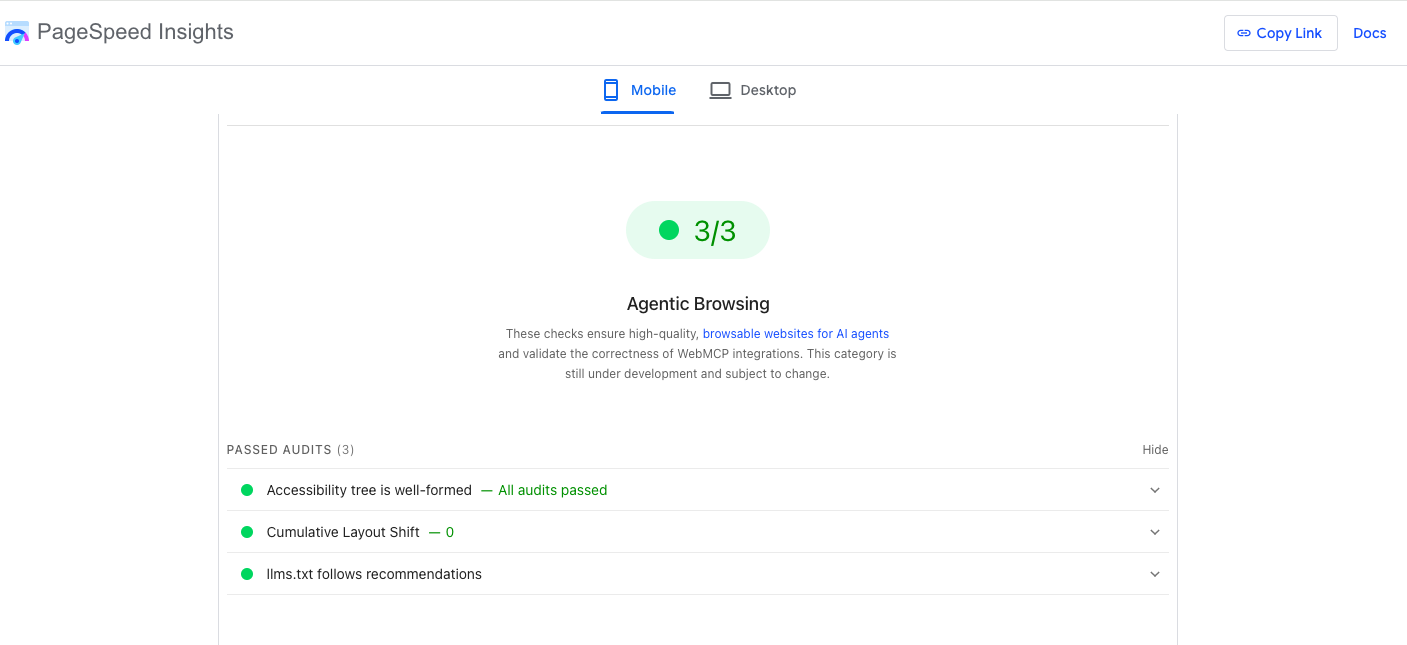
This is why Cumulative Layout Shift became one of the three Agentic Browsing audit checks in Lighthouse 13.3. It measures the exact property that determines whether an agent can complete a transaction on the page. The agent and the audit are looking at the same camera frames.
An AI search engine gives you a referral. An agentic browser gives you a transaction. The first is the next decade of SEO. The second is the next decade of conversion. A Machine-Readable Business is engineered for both — because the same page that lets one cite it is the page that lets the other complete its task.
vSourceCode · The Citation Engine · 01Why Google is not the audience for this work
You will hear an argument in SEO circles that llms.txt and machine-readability work do not matter, because John Mueller has said so on Google's own Search Off the Record podcast. He is technically correct — about Google's own surfaces.
Google does not need to cite anyone else's site because Google owns Gemini, Google Search and AI Mode. When Mueller cautions against llms.txt as a discovery mechanism, he is talking about Google's audience: itself. He is silent about ChatGPT, Claude, Perplexity, Grok and the next ten engines that have to make recommendations from external sources because they do not own the internet's content.
This series is about those engines. Google's internal position is informative; it is not instructive for the audience this work is for. Source: Search Off the Record, Episode 111 — Markdown vs HTML, with Martin Splitt and John Mueller, timestamp 17:30–21:00.
The self-audit — am I machine-readable today?
The honest answer for most small business sites in 2026 is no. The gap is not technical genius — it is small, specific, fixable engineering. Here is the diagnostic any business owner can run in an afternoon.
GPTBot, ClaudeBot, PerplexityBot, OAI-SearchBot, Anthropic-AI, ChatGPT-User, Google-Extended. Any listed under Disallow means that engine cannot cite you. Many WordPress security plugins block these by default.application/ld+json. If you find a clean Organization or Person schema with a populated sameAs array pointing to your public profiles, your identity is verifiable. If you find none, an AI engine evaluating whether you are a credible source has very little to anchor that decision to.Most sites fail four or five of these checks. A site that fails all five is not in the conversation. A site that passes all five is engineered for the audience the next decade will increasingly be made of.
The bus is arriving
Most small businesses missed the Google Search bus between roughly 2005 and 2010. The ones who understood early that organic visibility was about to become the largest distribution channel in the modern economy spent five years engineering for it and the next fifteen collecting the dividend.
The ones who waited paid an inflated cost-per-click forever after. By the time they tried to compete on organic, the SEO discipline had matured, the competition had compounded, and the early-mover advantage was no longer available at any price.
The next bus is arriving in 2026. The audience doing the searching, comparing, recommending and increasingly transacting on behalf of human customers is the AI agent. The discipline of engineering for that audience has not yet matured. The competition has not compounded. The early-mover window is open and measurable in months, not years.
What changed in 2026 is not that the audience appeared — the audience has been growing since 2023. What changed is that the measurement tools caught up. PageSpeed Insights now scores you on it. Lighthouse audits for it by default. The signals are public, the deltas are observable, the diagnostic is repeatable.
The businesses that catch this bus will spend the next decade being the ones the AI recommends. The businesses that wait will spend the next decade wondering why their phones stopped ringing, while their analytics dashboard, designed for an audience that no longer exists, reports nothing remarkable.
A Machine-Readable Business is not a website with AI features. It is a website that the new audience — the autonomous, parsing, transacting machine acting on a human's behalf — can read, trust, parse, and act on without breaking. That is not a marketing problem. It is an engineering problem. It is solvable. The discipline now has a name.
What comes next in this series
The next piece — How ChatGPT, Claude, Gemini and Perplexity Decide Who To Cite — goes engine-by-engine through what each one actually fetches, what signals each one weighs, and which agentic browsers transact differently from which AI search engines. That is the reference piece for the discipline.
Subsequent pieces cover the diagnostic instrument (how to monitor AI bot traffic in your server logs as a live KPI), the case study (what an AI-cited page looks like under the hood, with code), and the architectural piece (what comes after Citation Engine Optimization — sites built for machines as the primary audience).
The work is current, the signals are measurable, the methodology is documented as it forms. This is the field guide for the bus arriving.
Common questions about Citation Engine Optimization
What is Citation Engine Optimization in plain language?
It is the engineering discipline of making a website readable and trustworthy enough that AI engines — ChatGPT, Claude, Gemini, Perplexity, and the new generation of agentic browsers — preferentially cite that site by name when answering user questions. It differs from SEO in that the goal is being named as the answer, not ranking on a results page that no longer appears in the user's flow.
How is Citation Engine Optimization different from GEO or AEO?
All three terms describe overlapping disciplines, and the industry has not yet settled on a single name. Generative Engine Optimization (GEO) tends to focus on generative AI overviews specifically. Answer Engine Optimization (AEO) tends to focus on featured-snippet and zero-click results. Citation Engine Optimization, as defined here, focuses on being named by AI engines in citation form — the engineering signals that lead to a specific URL appearing as the source of an AI-generated answer. The three terms will likely converge. The discipline is the same; the framing differs.
If Google says llms.txt does not matter, why work on it?
Because Google is not the audience for this work. Mueller's caution is about Google's own surfaces, where llms.txt cannot help — Google does not need to cite external sources because it is the source. The audience for Citation Engine Optimization is the engines that do cite external sources: ChatGPT, Claude, Perplexity, Grok, and the agentic browsers. Working on llms.txt has near-zero cost and asymmetric upside in citation pools where it does matter.
What is an agentic browser and how is it different from an AI search engine?
An AI search engine fetches sources, summarises them, and produces a cited answer. The result is a referral. An agentic browser — Computer Use, Operator, Project Mariner, Comet, Arc Search — goes further: it visits the page on the user's behalf, interacts with it, and returns a task result. The result is a transaction, not a referral. Engineering for agentic browsers requires the same machine-readability work plus visual stability sufficient for an agent to interact deterministically.
How fast can a business become machine-readable?
The five-signal foundation is roughly two to six weeks of focused engineering for most small business sites, depending on starting position. Crawl access is a one-line robots.txt change. Render stability typically requires moving high-traffic pages to edge infrastructure outside the CMS — about a week of well-defined project work. Structural clarity is a content-and-schema audit that takes another week. Trigger-language layering is ongoing editorial work that compounds over months. Verifiable identity is a single /about page that takes an afternoon.
What is the conversion difference between AI citation traffic and Google search traffic?
Across industry studies tracked between mid-2025 and 2026, AI-citation referral traffic converts at roughly 12–15% of sessions, compared to 2–3% for standard Google organic traffic. A user clicking a Google result is browsing. A user arriving because an AI cited the site as the answer to their direct question is shopping. The AI has already done the comparison work. The site receives the user at a later stage of buying intent than organic search can typically deliver.
Sources & references
Google Search Off the Record — Episode 111 transcript, Markdown vs HTML (Splitt and Mueller)
Google Lighthouse — Agentic Web audit documentation · Accessibility tree guidance for AI agents
Google PageSpeed Insights — Release notes and category documentation
llmstxt.org — The llms.txt specification
OpenAI — GPTBot, OAI-SearchBot and ChatGPT-User documentation
Anthropic — ClaudeBot and Computer Use documentation
web.dev — Cumulative Layout Shift metric
vSourceCode — Google Just Added the 5th Element · Seven Billion AI Visits, Your Business Appears in None · The AI Eviction Notice · The Citation Gap concept · The Citation Engine Optimization concept