Seven billion AI visits a month. Your business appears in none of them.
Every day, customers ask AI engines for recommendations in your category. Those engines name your competitor and never mention you. Your analytics record nothing. Your agency has never measured it. The gap has been growing for two years.
The Story
The call that went to your competitor
It was 9pm on a Tuesday. Someone in your city had a problem you solve professionally. They picked up their phone. They did not open Google. They opened ChatGPT. They typed a question that, two years ago, would have produced ten blue links and a long evening of comparing options.
This time it produced an answer. A clean paragraph naming one business in their category, with a phone number and a one-line reason it was the right choice. They tapped the number. They called.
It was not you.
Your analytics recorded nothing. Your Search Console showed no missed impression. Your agency’s report looked normal. Nothing in any system you own gave you any signal that this customer existed, that this query was asked, or that a competitor was named as your replacement.
You did not lose this customer because your offer was weaker. You lost them because you were not in the conversation. The decision happened in a room you were not invited into, and the verdict was delivered before you knew the case was being heard.
This happens dozens of times a week, in every category, in every city. Most business owners have never been told.
The Five Engines
The new front door to your market
As at February 2026, the five largest AI engines processed approximately seven billion combined visits per month. Each is a new entry point to your category — with click-through to organic results having collapsed from 1.76% to 0.61% on queries where AI Overviews appear.
Sources: Similarweb (worldwide, all-device traffic panel) · DemandSage Analytics · Wytlabs 2026 Audit. Combined-visit figures compiled February 2026.
Update · August 2026: the seven-billion figure above is the February 2026 baseline and is retained as published. On Similarweb’s worldwide panel the combined total has since risen past ten billion visits per month, with Gemini the largest single mover — from roughly 805 million to approximately 2.9 billion monthly visits. The February baseline therefore understates the current position; it has not been revised upward here because the article’s argument does not depend on the larger number. Current figures: Similarweb, Gen AI traffic statistics.
The Concept
Citation Gap — the score you have never seen
Every buying query asked in your category generates an answer. That answer names a business. Across the five engines, across the dozens of variations of that query, across months of compounding, those answers are building a scoreboard.
The Citation Gap is the difference between how often your business is named in AI engine answers and how often your closest competitor is named — across buying-intent queries in your category.
It is a measurable scoreboard most business owners have never seen, even though their competitive position on it has been decided for two years or more.
Most businesses score zero. They have never measured it. They do not know the scoreboard exists. They have spent two years losing on it and have no record of any defeat.
The Citation Gap is the first metric that turns invisible competitive loss into a number you can see — and therefore close.
The Economics
A citation is not equivalent to a click
A visitor arriving from an AI engine has already received a synthesised recommendation. They have already crossed the consideration phase inside the engine. By the time they reach your site, they are not browsing. They are deciding.
Sources — conversion rates (14.2% vs 2.8%): Opollo, “Why AI Search Traffic Converts 5× Better Than Google” (Steven Morey, published 21 February 2026; data period Q3 2024–Q1 2025), study of 312 IT and technology brands in Opollo’s own client portfolio, UTM-attributed. Conversion events are lead actions — form submissions, demo requests, enquiries and content downloads — not completed purchases. Time on site (+41%) and bounce rate (−23%): Adobe Digital Insights, February 2025 data.
Scope note: the conversion figures are drawn from a B2B technology portfolio and the engagement figures from US retail, travel and banking sites. Both are presented as directional benchmarks for the AI-referred channel, not as measured rates for any individual local-service business. Your own rate should be measured, not assumed.
In the Opollo dataset, AI referrals accounted for only 2–8% of total inbound traffic while converting at roughly five times the rate of Google organic. The channel is small and disproportionately productive. Broken down by engine, Claude referrals converted at 16.8%, ChatGPT at 15.9% and Perplexity at 10.5%, against 2.8% for Google organic. A citation costs nothing per click and arrives pre-qualified — the engine has already done the comparison work the visitor would otherwise still be doing.
The Principle
The rule that makes SEO irrelevant for citation
of the URLs cited in Google’s AI Mode answers do not appear in the Top 10 organic results for the same query. The engine is not ranking. It is extracting — prioritising information density, structural clarity, schema markup and load speed over backlink authority.
Source: SE Ranking, 10,000-keyword AI Mode study, reported by Search Engine Journal — 14% of AI Mode URLs matched the Top 10 organic results for the same query; 17.9% of queries had no overlap at all.
Scope: this figure measures Google’s AI Mode. Google’s AI Overviews behave differently — roughly 40% of AI Overview sources rank below the Top 10 — and no equivalent published measurement exists for ChatGPT, Claude or Perplexity. Treat 86% as an AI Mode figure, not a universal one.
A page that scores nowhere on Google can be the cited answer in every AI engine — and the reverse is equally true. Your rival may rank nowhere you can monitor and still be the answer in every engine your customer uses.
The mechanics of how engines read and select a source are set out in The Machine Readable Business.
The competitive advantage they have built is invisible to your tools, your agency, and your Search Console reports. It is also winnable for you, regardless of how you currently rank. The game is different. The rules favour engineering over authority.
The Architecture
Three machines. One page. Three verdicts.
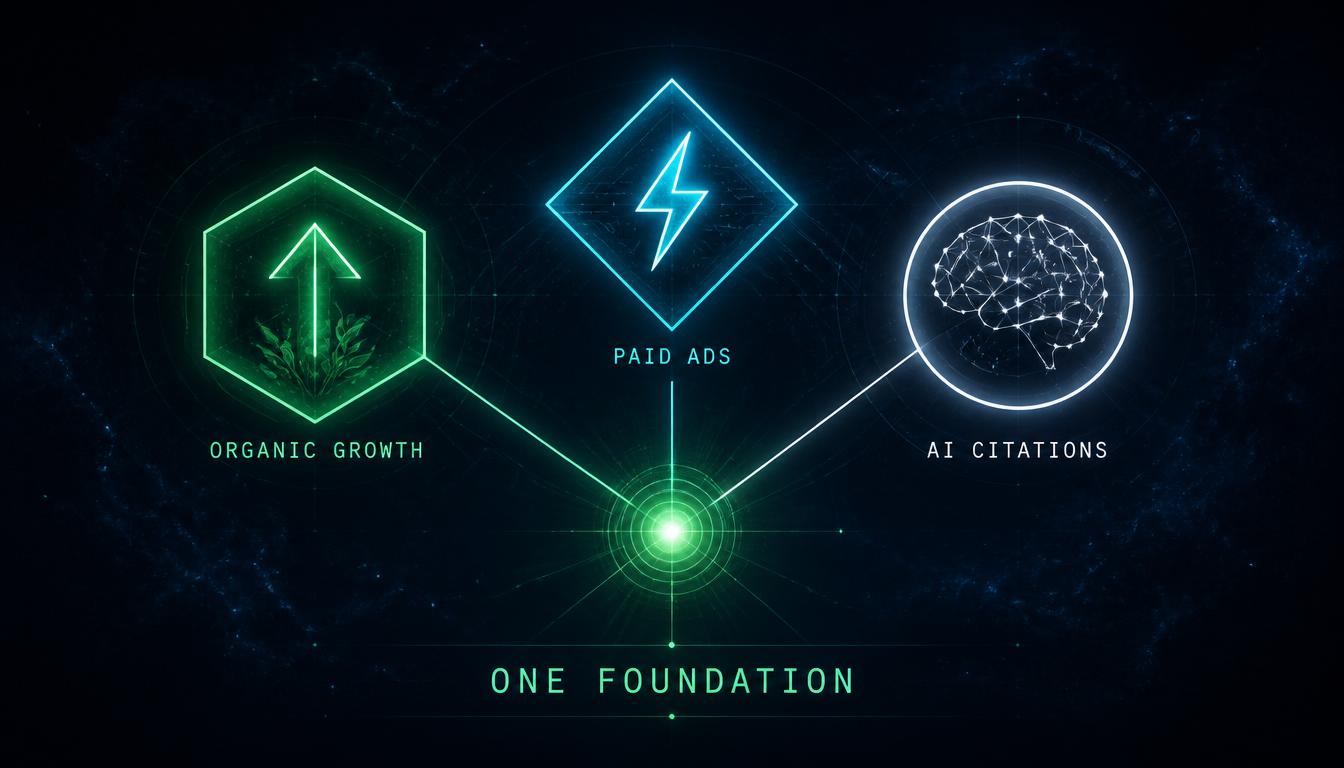
Your landing page is scored simultaneously by three different systems — all reading the same underlying characteristics. Fix the page once, win three times.
Most businesses lose on all three simultaneously and treat each as a separate problem requiring a separate vendor and a separate invoice. They are one problem in three places.
The Self-Test
Measure your Citation Gap in ten minutes
No subscription, no vendor, no paid tool. Five steps.
If your score is under 5 and your rival is over 15, you are not in a marginally disadvantaged position. You are absent from the room where the buying decision is being made.
The Answers
Questions AI engines are asked — about this exact topic
The difference between how often your business gets named when someone asks an AI engine for a recommendation in your category and how often your closest competitor gets named. Same queries. Same engines. Same buying intent. Most businesses are losing this comparison by wide margins and have no record of it — because the loss leaves no trace in any standard analytics system.
For a growing category of commercial queries — local services, professional recommendations, product comparisons — yes. As at February 2026, the five major AI engines handled roughly seven billion visits per month between them, and the figure has grown since. Queries that used to send traffic to individual websites are increasingly answered inside the engine, with a named recommendation and contact details, before the user ever reaches a results page. The click-through rate from Google to organic results has dropped from 1.76% to 0.61% on queries where an AI Overview appears.
Regularly — especially for service business recommendations and professional referrals. ChatGPT processed roughly 5.5 billion visits a month as at February 2026. A significant portion are people asking what used to be a Google question: who should I call for this? Google returned a list and the user chose. ChatGPT returns a name and the user calls. Your ability to compete on that outcome depends entirely on whether the engine has chosen to name you.
Yes — with a business name, phone number, address, and a stated reason for the recommendation. When someone asks “recommend a plumber in [city]” or “best dentist near [area],” the engine produces exactly that output. The business cited most consistently across queries in its category builds citation equity — a compounding asset that grows stronger with each correct citation and becomes harder for competitors to displace over time.
By having a page the engine can read fully, quickly, and without waiting for scripts to finish. Load speed under two seconds on mobile. Clean heading structure. Schema markup. Direct answers to common questions placed immediately under relevant headings. These are infrastructure decisions, not content decisions. The words matter less than the architecture delivering them.
The AI engine answer. Not the search results page. Not the ad. The answer the engine produces when a prospective customer asks who to call. That answer names a business. If it names yours, the customer is already leaning toward choosing you before they visit your site. If it names your competitor, the visit never happens — and nothing in your analytics records the event.
Because citation losses do not register in any standard system. When an AI engine recommends your competitor and a customer calls them, your Google Analytics records nothing. Your Search Console shows nothing. Your call tracking logs nothing. The query, the answer, the decision — all happened inside an engine your systems cannot see. This is why businesses with strong rankings, stable traffic, and active campaigns are watching their phones ring a little less each month without being able to explain why.
Measure it. Run the five-step test in this article against your closest competitor. Note both scores. That difference is your Citation Gap in its simplest form. From that number, the signals creating the gap become identifiable — and each one has a specific fix. The second article in this series covers all five signals and what addressing each one changes.
Most businesses never discover their Citation Gap until they audit it.